


Las Vegas has become one of the country’s most prominent sports and entertainment destinations, with Allegiant Stadium already anchoring a major sports district and a new Athletics ballpark taking shape on the south end of the Las Vegas Strip.
These projects are changing how parts of the valley are developed, used, and viewed by buyers.
For homebuyers, however, the effects are more nuanced than simply assuming that every property near a stadium will increase in value. Location, property type, traffic, zoning, rental regulations, and the timing of surrounding development all matter.
Understanding the Las Vegas stadium district property impact can help buyers evaluate opportunities more realistically.
Understanding the Las Vegas Stadium District Property Impact
The impact of the Las Vegas stadium district on property is overwhelmingly positive for homeowners and investors. The influx of new infrastructure, upscale retail, and walkable entertainment zones creates tremendous effects on Las Vegas stadium district real estate, significantly boosting property values and rental demand for residential spaces within a two-mile radius.

Exploring the Las Vegas Stadium Deal and Development
The Economics of the Area
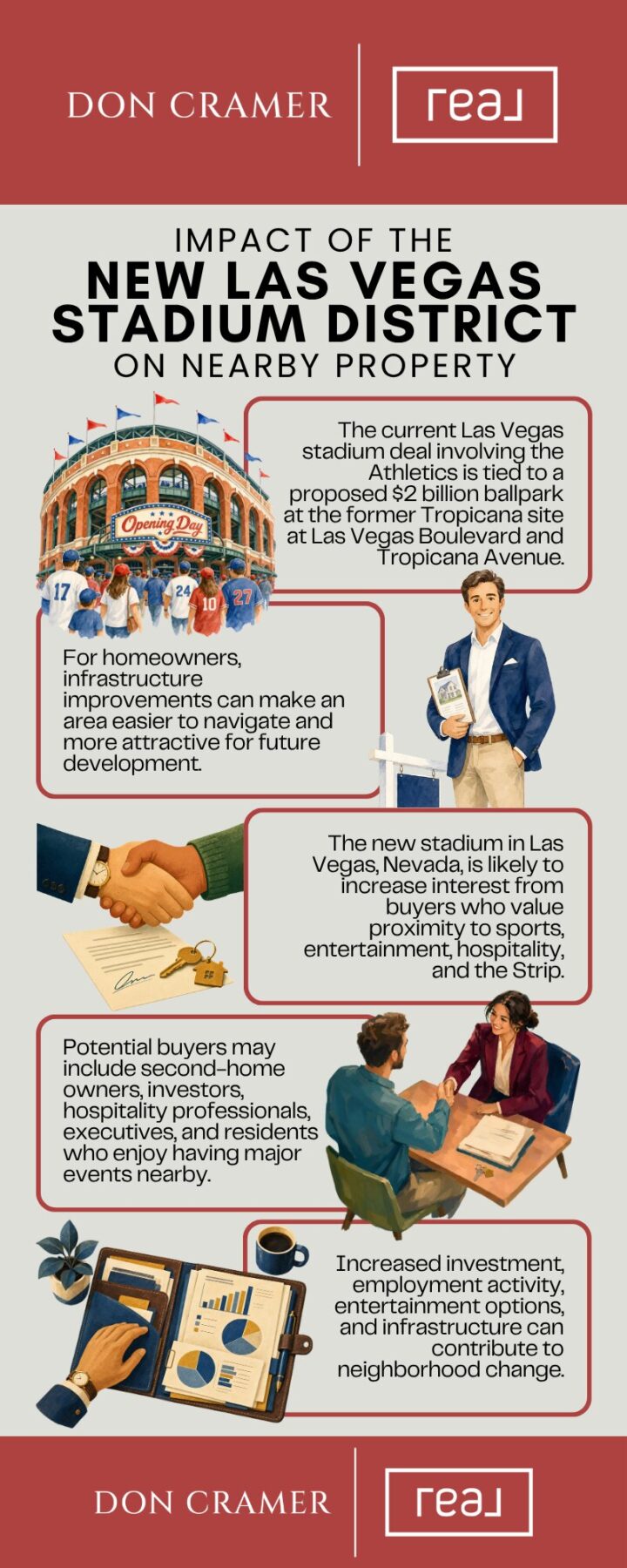
The current Las Vegas stadium deal involving the Athletics is tied to a proposed $2 billion ballpark at the former Tropicana site at Las Vegas Boulevard and Tropicana Avenue.
Construction began in 2025, and the project is being developed as a 33,000-capacity facility with a targeted opening for the 2028 season.
The ballpark is only one component of the broader redevelopment story. Bally’s has proposed a separate mixed-use project on the surrounding portion of the former Tropicana property, including hotel, gaming, dining, retail, entertainment, and theater uses.
Because that surrounding development is being phased separately from the ballpark, buyers should distinguish between confirmed construction and proposed future projects.
That distinction matters when assessing Las Vegas stadium district real estate effects. A planned restaurant, hotel, retail center, or residential project can influence an area’s future appeal, but a proposal should not be treated as an existing amenity.
Infrastructure Upgrades
The existing Stadium District Plan around Allegiant Stadium is a land-use and transportation framework intended to guide future development.
It identifies opportunities to improve pedestrian connections, street connectivity, transportation, and redevelopment within an area that historically included substantial industrial uses.
For homeowners, infrastructure improvements can make an area easier to navigate and more attractive for future development. At the same time, major event venues can create concentrated traffic and pedestrian activity.
Buyers should therefore consider both everyday accessibility and what the neighborhood is like during major events.

How the New Stadium in Las Vegas, Nevada, Affects Housing
The Shift in Buyer Demographics
The new stadium in Las Vegas Nevada is likely to increase interest from buyers who value proximity to sports, entertainment, hospitality, and the Strip.
Potential buyers may include second-home owners, investors, hospitality professionals, executives, and residents who enjoy having major events nearby. However, there is no reliable basis for assuming that a specific buyer demographic will dominate every neighborhood surrounding the ballpark.
Las Vegas remains a large and diverse housing market, and demand differs significantly between the Strip corridor, established residential neighborhoods, and suburban communities.
Transforming the Las Vegas Stadium District
The Las Vegas stadium district around Allegiant Stadium is already being considered for additional commercial, entertainment, and mixed-use activity. The county’s planning framework envisions greater connectivity and a transition from portions of the area’s historic industrial character toward a broader mix of uses.
For buyers, this can create an interesting trade-off. Living close to a major venue can provide access to entertainment and employment centers, while properties farther away may offer more traditional residential environments with less event-related activity.
Rather than assuming that every nearby property will benefit equally, buyers should compare specific streets, developments, views, parking arrangements, and traffic patterns.

Evaluating Nearby Las Vegas Properties for Investment
Short Term Rental Opportunities
There is clear tourism and event-related demand in Las Vegas, but buyers should be careful before purchasing nearby Las Vegas properties specifically for short-term rental income.
Clark County regulates short-term rentals through its licensing system and local ordinances. Not every residential property is eligible, and eligibility can depend on the property’s location, zoning, ownership structure, and other requirements.
A major sporting event can create periods of elevated accommodation demand, but that does not automatically make a particular home a profitable short-term rental. Investors should examine licensing requirements, operating costs, insurance, HOA restrictions, projected occupancy, and comparable rental performance before purchasing.
Long Term Appreciation
For buyers planning to own a property for several years, stadium development can be one factor in a broader appreciation strategy. Increased investment, employment activity, entertainment options, and infrastructure can contribute to neighborhood change.
Still, major development is not a guarantee of higher home values. Buyers should also consider supply, interest rates, employment trends, new construction, neighborhood quality, and broader housing-market conditions.
A property located a few blocks farther from an entertainment venue may sometimes provide a different balance of accessibility, privacy, and price than one immediately adjacent to it.

Navigating the Broader Las Vegas Real Estate Market
The Ripple Effect
The effects of major sports development can extend beyond the immediate stadium site. Buyers who want access to the Strip and major sporting events may also consider established residential communities elsewhere in the valley.
Henderson and Summerlin, for example, offer very different residential environments from the areas immediately surrounding the Strip. Their appeal is influenced by schools, amenities, employment access, neighborhood design, housing options, and lifestyle preferences rather than stadium proximity alone.
For that reason, the Las Vegas stadium district real estate effects should be viewed as one part of the broader Las Vegas housing story rather than a market-wide guarantee.
Working With Local Experts
Development plans can change, and projects surrounding major venues often move forward in phases.
A knowledgeable local real estate professional can help buyers review zoning, planned developments, recent comparable sales, property-specific restrictions, and transportation changes.
This is especially useful when comparing properties that appear similarly priced but have different exposure to future development. A buyer may prefer a property close enough to benefit from new amenities without being directly exposed to event traffic and construction.
Stadium District Real Estate Comparison Table
| Property Feature | Inside Stadium District | Traditional Las Vegas Suburb |
|---|---|---|
| Property Appreciation | Potential for increased demand, but highly location-specific | Generally influenced by broader neighborhood and market conditions |
| Rental Demand (Short-Term) | Potentially stronger during major events, subject to regulations | Typically less event-driven |
| Primary Property Type | Mixed-use, condominiums, apartments, commercial properties, and surrounding residential options | Predominantly single-family homes, with condos and townhomes in some communities |
| Walkability | Generally greater around major venues and commercial corridors | Varies considerably; many areas are more car-dependent |
| Noise and Traffic | Potentially higher during major events | Generally lower in residential areas away from major venues |
Capitalize on the Sports Renaissance
The growth of Las Vegas as a sports and entertainment destination is creating new development opportunities, but smart real estate decisions require more than simply buying as close to a stadium as possible.
The Las Vegas stadium district property impact can include increased development activity, greater visibility, new commercial investment, and changing demand patterns. It can also involve construction disruption, traffic, noise, and regulatory considerations.
The Athletics ballpark is currently being built at the former Tropicana site, while the existing Stadium District around Allegiant Stadium continues to be shaped by long-term land-use and transportation planning. Together, these developments are important factors to watch in the Las Vegas real estate market.
For buyers considering nearby Las Vegas properties, the most useful approach is to evaluate the specific property, its surrounding development pipeline, access, zoning, rental rules, and comparable sales before making an offer.
If you are considering purchasing a home or investment property near the Las Vegas stadium developments, getting property-specific guidance can make the difference between simply buying near the action and finding a property that actually fits your goals.
For help evaluating current opportunities, zoning, development plans, and nearby properties, contact a local Las Vegas real estate professional at +1 702-427-6703 or info@vegashomesnv.com.
Frequently Asked Questions
What exactly is the Las Vegas stadium district property impact for current homeowners?
The impact varies by neighborhood and property. Stadium-related development can increase commercial activity and demand for nearby locations, but homeowners may also experience more traffic, noise, construction, and event activity. Historical research on the Raiders’ relocation found that effects on residential values varied by distance and property characteristics.
How has the Las Vegas stadium deal changed local zoning laws?
The Athletics project was enabled through state legislation and a broader public-private development framework. However, buyers should not assume that the stadium deal automatically rezoned all surrounding properties. Specific zoning changes must be evaluated on a property-by-property basis through Clark County or the applicable local jurisdiction.
Will the Las Vegas stadium being built cause property taxes to increase?
Not automatically. Nevada property taxes are based on assessed valuation and applicable tax rates, with statutory limitations on annual tax increases for qualifying properties. A stadium project itself does not mean every nearby homeowner will receive a corresponding property-tax increase. Buyers should review the property’s current tax history and assessment with the county assessor.
What types of nearby Las Vegas properties are best for real estate investors?
There is no single property type that works for every investor. Condominiums, townhomes, single-family homes, and other properties can have different purchase prices, rental restrictions, maintenance costs, and appreciation characteristics. Investors interested in short-term rentals should verify eligibility and licensing requirements before purchasing.
How does the new stadium in Las Vegas, Nevada, affect local traffic for residents?
Major events can increase traffic and pedestrian activity around stadium areas. The Stadium District Plan specifically addresses transportation, pedestrian connectivity, and street-network improvements around Allegiant Stadium. Buyers should visit prospective neighborhoods during both ordinary days and major events before deciding where to purchase.
Are there any new residential builds available within the Las Vegas Stadium District?
Development around the stadium areas includes a mixture of planned commercial, hospitality, entertainment, and mixed-use projects. The exact availability of residential properties changes as projects are proposed and completed. Buyers should check current listings and approved development plans rather than relying on older project announcements.
How does stadium district development influence the overall Las Vegas real estate market?
Stadium development can contribute to investment and increased activity around particular corridors, but it does not determine the performance of the entire Las Vegas housing market. Interest rates, employment, population growth, housing supply, new construction, and buyer demand all remain important factors.